Certificate walkthrough
Guide to your Certificate of Analysis
All certificate explanations
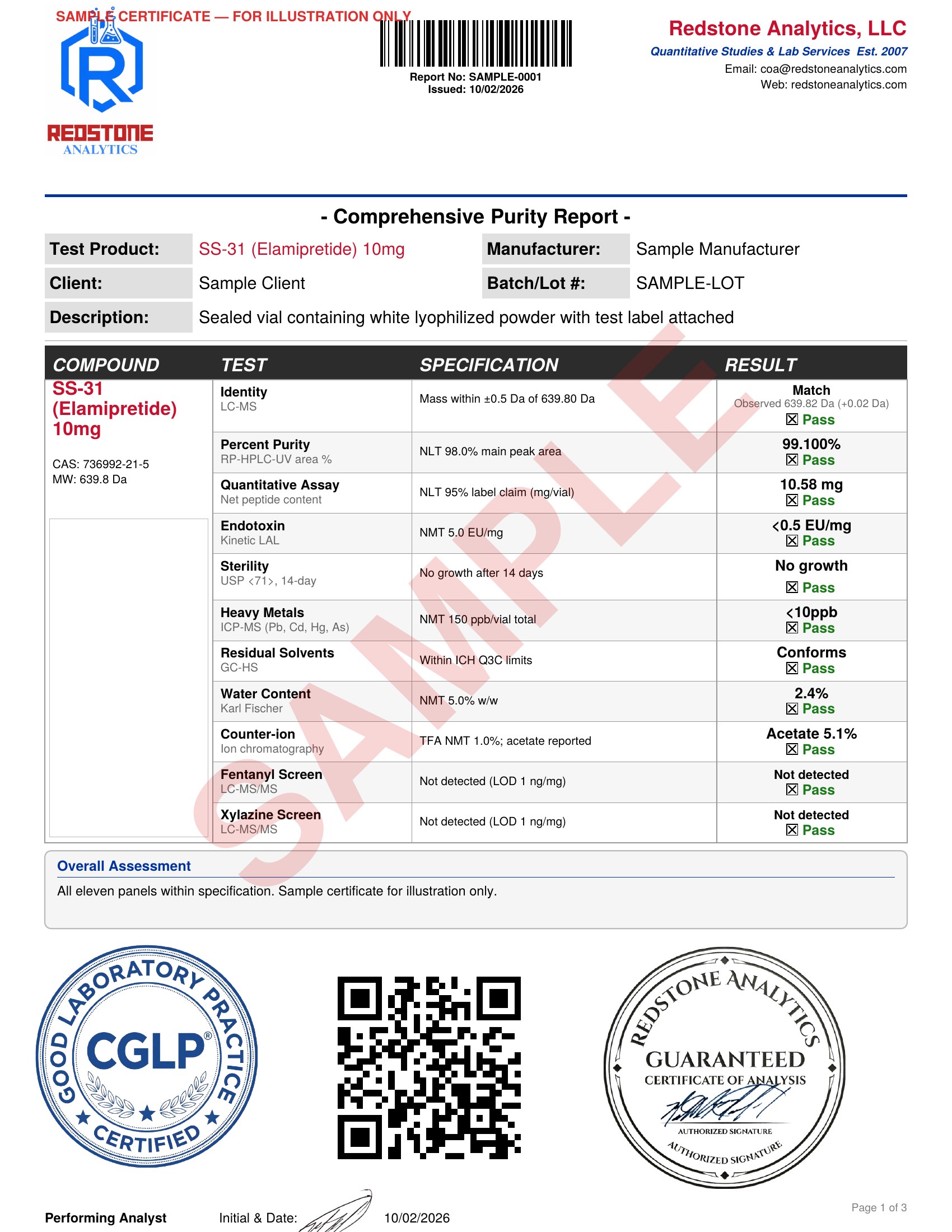
Report number & barcode
Every certificate has a unique report number and the date it was issued. Anyone holding the number can confirm the certificate is genuine at redstoneanalytics.com/lookup — if the lookup doesn't find it, the document didn't come from us or has been changed.
Why it matters: a PDF can be edited; the record on our server can't. Always verify a certificate you didn't receive directly from the lab.
Issuing laboratory
The lab that performed the testing and how to reach it. Certificates are issued by Redstone Analytics, LLC.
Sample details
What was tested and for whom: the product and strength as labelled, the manufacturer, the client that ordered the test (printed as they chose), the batch or lot number, and a description of the vial as it arrived.
Match these to the vial in your hand — product, strength and lot should all agree.
Compound, CAS and molecular weight
The compound the results refer to, its CAS registry number (a unique chemical identifier) and molecular weight in daltons. The molecular weight is what the mass spectrometer is checked against in the Identity row.
How to read the results table
Each row is one test. TEST says what was measured and by which method; SPECIFICATION is the acceptance limit (NLT = not less than, NMT = not more than); RESULT is the measured value with a Pass or Fail box.
1 · Identity (LC-MS)
Is it the right molecule? The sample is run through HPLC into a mass spectrometer and the measured mass is compared with the theoretical mass of the labelled compound. 'Match' with the observed mass and the difference (here +0.02 Da against a ±0.5 Da window) confirms identity.
A different peptide would be tens or hundreds of daltons off — this is the most definitive identity test.
2 · Percent Purity (RP-HPLC-UV area %)
How clean is the peptide? The main peak's area divided by the total area of all peaks in the HPLC trace. 99.100 % means 99.1 % of the UV-absorbing material is the main compound; the rest is related impurities. The chromatogram on page 2 is the evidence behind this number.
Typical research-grade peptide is 98–99.9 %. Purity says nothing about how much is in the vial — see the next row.
3 · Quantitative Assay (net peptide content)
How many milligrams of peptide are actually in the vial, measured against a reference by UV/HPLC. Here 10.58 mg for a vial labelled 10 mg.
Fill weight includes water and counter-ion, so ±10 % of the label is normal.
4 · Endotoxin (kinetic LAL)
Bacterial endotoxins are fragments of bacterial cell walls that cause fever and inflammation if injected — they survive filtration and can be present even when nothing is alive. Measured by the kinetic turbidimetric LAL assay (USP <85>) and reported in endotoxin units per milligram.
'<0.5 EU/mg' means below the reporting limit against a 5.0 EU/mg specification.
5 · Sterility (USP <71>, 14-day)
Is anything alive in the vial? The sample is incubated in growth media for 14 days. Because incubation can't be shortened, Full Monty certificates are issued at day 3 with this row marked 'Pending' and reissued automatically at day 14 with the result.
Sterility and endotoxin are different questions: a sample can be sterile and still carry endotoxin.
6 · Heavy Metals (ICP-MS)
Lead, cadmium, mercury and arsenic measured by inductively coupled plasma mass spectrometry, which counts metal atoms at parts-per-billion levels.
'<10 ppb' against a 150 ppb total specification is a clean result.
7 · Residual Solvents (GC-HS)
Solvents used in synthesis and purification can remain in the powder. Headspace gas chromatography measures them against the ICH Q3C limits used by pharmaceutical manufacturers.
8 · Water Content (Karl Fischer)
How much of the powder's weight is water, by Karl Fischer titration. Water adds to fill weight without adding peptide and can shorten shelf life; the specification is not more than 5 % by weight.
9 · Counter-ion (ion chromatography)
Synthetic peptides carry a salt partner from purification — usually acetate or trifluoroacetate (TFA). We report which one and how much. Acetate is the preferred form; TFA is limited to 1 %.
10 · Fentanyl Screen (LC-MS/MS)
A targeted tandem-mass-spectrometry screen that watches specifically for fentanyl down to about 1 nanogram per milligram. 'Not detected' is the expected result; any detection fails the row.
This is a contamination screen on the peptide. We do not accept controlled substances themselves for testing.
11 · Xylazine Screen (LC-MS/MS)
The same targeted screen for xylazine, an adulterant of concern. 'Not detected' at a 1 ng/mg limit of detection.
Overall assessment
The lab's one-line conclusion. If any row fails, it says which and why — results are reported as measured and never withheld or altered.
Seals and QR code
The QR code opens this certificate's verification page. The seals and signature mark the certificate as reviewed and issued by the lab.
Performing analyst
Initials and date of the analyst who performed and signed off the work. Page numbers show how many pages the complete certificate has — a one-page copy of a three-page certificate is incomplete.
HPLC analysis page
Page 2 is the raw evidence behind the purity number: the HPLC chromatogram for this sample, the detector used and the wavelength (here diode-array detection at 220 nm).
Main peak
The tall peak is the compound being tested, labelled with its name, retention time (12.45 min — how long it took to pass through the column) and its area percentage (99.100 %). Under fixed conditions each compound always elutes at the same retention time, which is a second identity check.
Minor peaks (impurities)
Small peaks are related impurities — a peptide missing an amino acid, an oxidized form, a protecting group left on. Each is labelled with its retention time and counted in the purity calculation.
The more and bigger the minor peaks, the lower the purity. A clean trace has one dominant peak and a flat baseline.
Axes
Vertical axis: detector signal (absorbance in milli-absorbance units) — how much UV light the eluting material absorbs. Horizontal axis: retention time in minutes from injection.
Integration results
The numbers behind the picture: every peak the software found, its retention time and its share of the total area. The main compound is in bold. Add the area % column and you get 100 %; the main peak's share is the purity on page 1.
Method summary
The instrument and detection wavelength used. Column chemistry, gradient and integration settings are held in the lab's method record and are not printed.
Research-use-only notice
What the certificate is and is not: analytical information about a research material. It is not a statement that the product is safe, approved or suitable for any use in people or animals.
Scope of testing
Results apply only to the specific vial and lot received by the lab. We can't vouch for what happened before it reached us or after it left — which is why batch numbers matter when you compare a certificate to a vial.
Research use only
The legal scope of the document: it is provided for research-use-only materials and analytical reference. No warranty of safety, efficacy or sterility is implied beyond the tests actually reported.
No endorsement or warranty
A certificate is not an endorsement of a product or a seller, and not a regulatory clearance. It reports what was measured.
No substitution for independent review
Recipients remain responsible for how the product is labelled, marketed, possessed and used, and for complying with the law where they are.
Verification
The direct verification link and QR code for this certificate. Enter the report number (or scan) at redstoneanalytics.com/lookup to confirm the certificate matches the lab's record.
How to verify a certificate
The direct verification link and QR code for this certificate. Enter the report number (or scan) at redstoneanalytics.com/lookup to confirm the certificate matches the lab's record.
Verify a certificateFull Monty vs. standard certificate
The standard certificate has 6 result rows (identity, purity, quantitative assay, heavy metals, TAMC, TYMC); the Full Monty replaces the microbial counts with a 14-day sterility test and adds endotoxin, residual solvents, water content, counter-ion, fentanyl and xylazine.
Full Monty 11-panel testThe certificate shown is a sample for illustration. Real certificates carry a report number that can be verified online.